
Executive Summary (The Deep Dive)
You know the basics: Dye Sublimation is soft, Silk Screen is textured. But to scale from selling 50 lanyards to selling 5,000 corporate units, you need to understand Manufacturing Physics and Global Logistics.
When you order 1,000 units, a small mistake in color calibration or a delay in customs can cost you thousands of dollars. This guide moves beyond "Design" and into "Industrial Engineering" and "Supply Chain Management."
The Master Checklist:
- Color Theory: Why your screen’s blue is not the fabric’s blue.
- Defect Prevention: How to spot "Ghosting" and "Bleeding" before it happens.
- Eco-Compliance: The rise of RPET and why major corporations mandate it.
- Logistics: The art of "Hotel Drops" for convention emergencies.
I. The Color Crisis: CMYK vs. Pantone (PMS) on Fabric
The #1 cause of disputes between designers and factories is color. "It looks dull" or "The red is too orange" are common complaints.
The Physics of Heat Transfer
Dye Sublimation isn’t just printing; it’s chemistry.
- The State Change: Ink is printed on paper. It is then pressed against polyester at 400°F (200°C). The solid ink turns into gas and permeates the fabric fibers.
- The Shift: Heat changes color. A "Royal Blue" on paper might turn "Purple" when heated if the temperature is too high.
- The Substrate: Polyester is not pure white; it has a texture. This naturally desaturates colors by about 5-10% compared to a glossy screen.
The Solution: The "Physical Match"
- Don’t trust the screen.
- The Pantone Formula Guide: If you are doing a corporate order (e.g., Coca-Cola Red), you must specify a Solid Coated Pantone Code (e.g., PMS 186C).
- The Limitation: Sublimation printers use CMYK ink sets to simulate Pantone colors. They can hit 90% of the gamut.
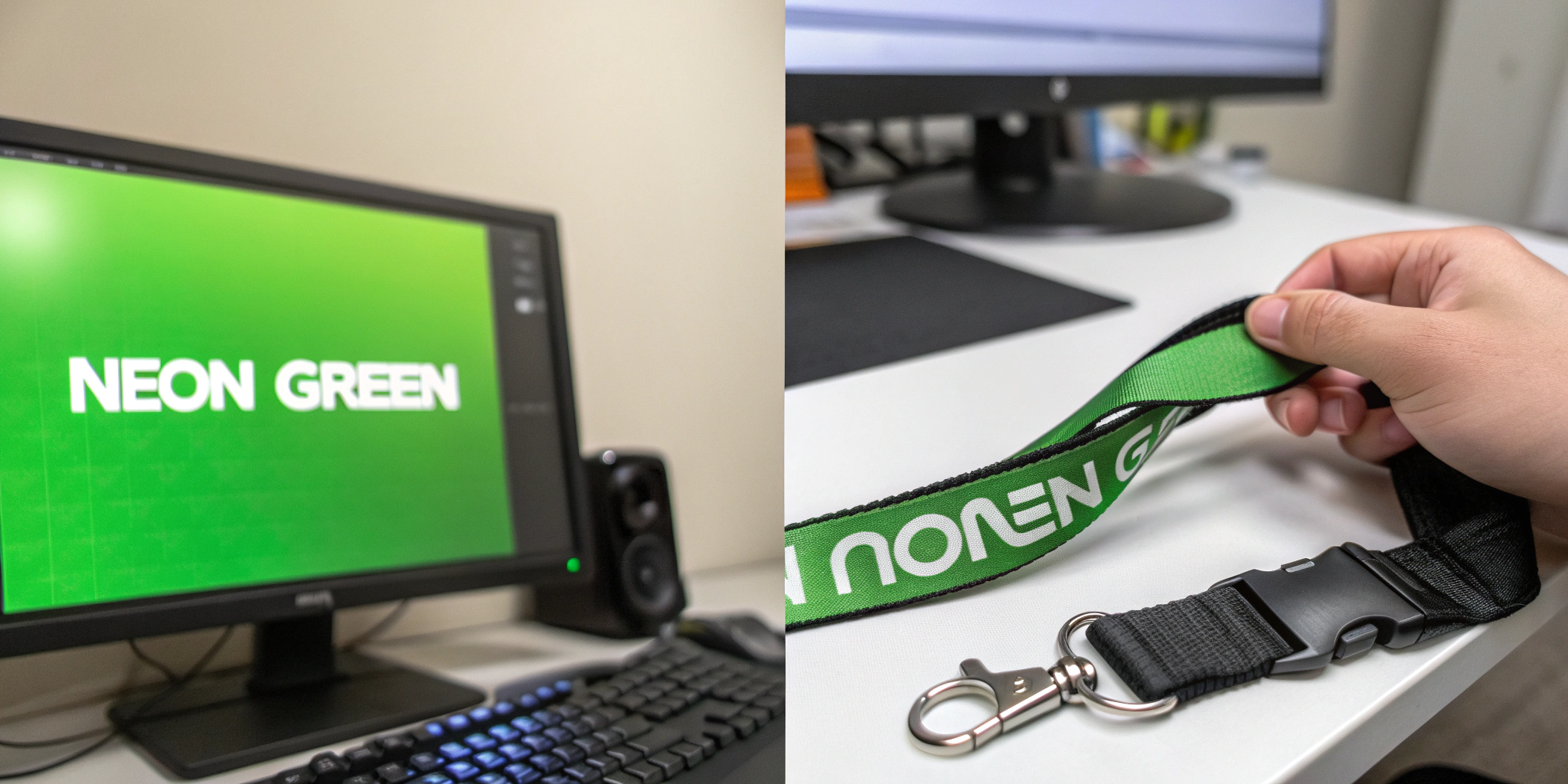
- Neon Warning: Standard CMYK cannot print "Neon/Fluorescent" colors. If you want a safety vest yellow, the factory needs special Fluorescent Inks, which cost extra.
II. Quality Control: Identifying "Ghosting" & "Registration" Errors
When you receive a box of 500 lanyards, how do you know if they are "A-Grade"?
1. Ghosting (The Blur)
- What it is: A double-image or blurry shadow effect on the text/logo.
- The Cause: During the heat press process, if the transfer paper shifts even 1 millimeter while the ink is turning into gas, it deposits the ink in two places.
- QC Rule: Inspect the fine text. If it looks like 3D glasses without the glasses, it is a reject.
2. White Fissures (The Stretch)
- What it is: When you stretch the lanyard, white lines appear in the design.
- The Cause: The factory printed on the fabric while it was relaxed. When you pull it, the fibers open up, revealing the unprinted white core of the polyester.
- The Fix: Ask for "Deep Penetration" printing (longer press time), though this can blur lines slightly.
3. Registration (Silk Screen Only)
- The Issue: If you have a Red circle with a White outline, and the White outline is shifted to the left, overlapping the Red.
- The Cause: The screen for the second color was not aligned perfectly with the first.
- Tolerance: Industry standard is 0.5mm. Anything more is a defect.
III. Sustainability: The RPET Revolution
In 2025, "Virgin Polyester" (new plastic) is becoming taboo for large events.
What is RPET?
- Definition: Recycled Polyethylene Terephthalate. It is made from recycled plastic water bottles.
- The Process: Bottles are shredded into flakes, melted into pellets, and spun into yarn.
- The Feel: It feels 95% identical to standard polyester. It might be slightly stiffer.
- The Marketing: You can legally label these "Eco-Friendly" or "Made from Recycled Plastic."
- The Premium: It costs about $0.10 – $0.20 more per unit.
- Why Buy It: Large corporate clients (Google, Salesforce, Universities) often have internal mandates to buy sustainable swag. Offering RPET wins you these contracts over competitors who only sell standard plastic.
IV. Advanced Hardware: Beyond the Neck
Customization doesn’t stop at the print. You can engineer the lanyard for specific utilities.
1. The "Shorty" (Motorcycle/Keychain Style)
- Length: 15cm – 20cm loop.
- Usage: It hangs out of a pocket. Motorcyclists use these to grab their keys with gloved hands without scratching their bike tank (fabric is soft, metal keychains scratch paint).
- Market: Car enthusiasts, bikers, skaters.
2. The Bottle Holder (O-Ring)
- Attachment: A rubber O-ring attached to the plastic buckle.
- Function: It stretches over the neck of a water bottle.
- Event Use: Music Festivals. Attendees need to carry water hands-free. Selling "Festival Ready Lanyards" is a huge niche.
3. The Double-Clip (Open Ended)
- Design: Instead of one clip at the bottom, there are two clips at the ends of an open rope.
- Use: For large "Event Passes" (A6 size) that have two holes at the top. This prevents the pass from spinning around.
- Client: VIP events, Backstage passes, Olympics.
V. Logistics: The "Convention Hotel Drop"
This is a high-risk, high-reward logistics strategy for artists and vendors traveling to conventions.
The Scenario
You are flying to Anime Expo in Los Angeles. You don’t have room in your suitcase for 500 lanyards (which weigh 15kg/33lbs).
The Strategy
-
Timing: Order from the Chinese factory 30 days before the event.
-
The Address: Do not ship to your home. Ship directly to your Hotel.
- Address Format:
- Your Name (GUEST: Arriving July 1st)
- C/O Front Desk – Hotel Name
- 123 Hotel Blvd, Los Angeles, CA
-
The Communication: Call the hotel beforehand. Ask for their "Package Holding Policy." Some charge a fee ($5-$10 per box).
-
The Risk: If customs delays the package by 2 days, you might miss the show. Always add a 7-day buffer.
-
The Benefit: You save hundreds of dollars in airline baggage fees and don’t have to carry heavy boxes through the airport.
Frequently Asked Questions (Masterclass Level)
Q: Why does my lanyard layout look different in the proof vs. reality?
A: The "Stitch Loss."
Designers often forget that the metal clamp or stitching takes up 2cm of fabric. If your design has a logo right at the bottom edge, it will be chopped in half or sewn over.
- Rule: Keep all critical logos 5cm away from the bottom tips of your art file.
Q: Can I mix-and-match hardware colors?
A: Yes, but with MOQs.
You can usually ask for a Black clip, a Silver clip, or a Gold clip.
- Trend: Black Matte Electroplated hardware (Black Hook + Black Rivet) is currently the most popular style for streetwear and tech brands. It looks stealthy and premium compared to cheap shiny chrome.
Q: How do I remove wrinkles from lanyards after shipping?
A: The Steamer.
Lanyards arrive tightly packed in bundles of 50, often with creases.
- Do not Iron: Ironing polyester can melt the fibers or ghost the ink if too hot.
- Use Steam: Hang them on a rack and use a handheld garment steamer. gravity + steam releases the wrinkles instantly.
Q: What is the HS Code for Lanyards (for Customs)?
A: 6307.90 (Other made-up textile articles).
Using the correct code prevents your package from getting stuck in a "Customs Exam" hold, which can delay delivery by weeks.