The journey isn’t over when the box arrives at your door. In fact, the work of Quality Control (QC) just begins. Unlike digital products, physical manufacturing has an error rate.
The Reality Check:
- Standard Defect Rate: 3% – 5% is industry average.
- The "Seconds" Sale: Selling imperfect items at a discount can recover 100% of the cost.
- Shipping Risk: A keychain is rigid. If mailed in a standard paper envelope, postal sorting machines will crush it.
Operational Score: Critical. Failing to QC leads to refunds. Failing to package correctly leads to destroyed inventory.
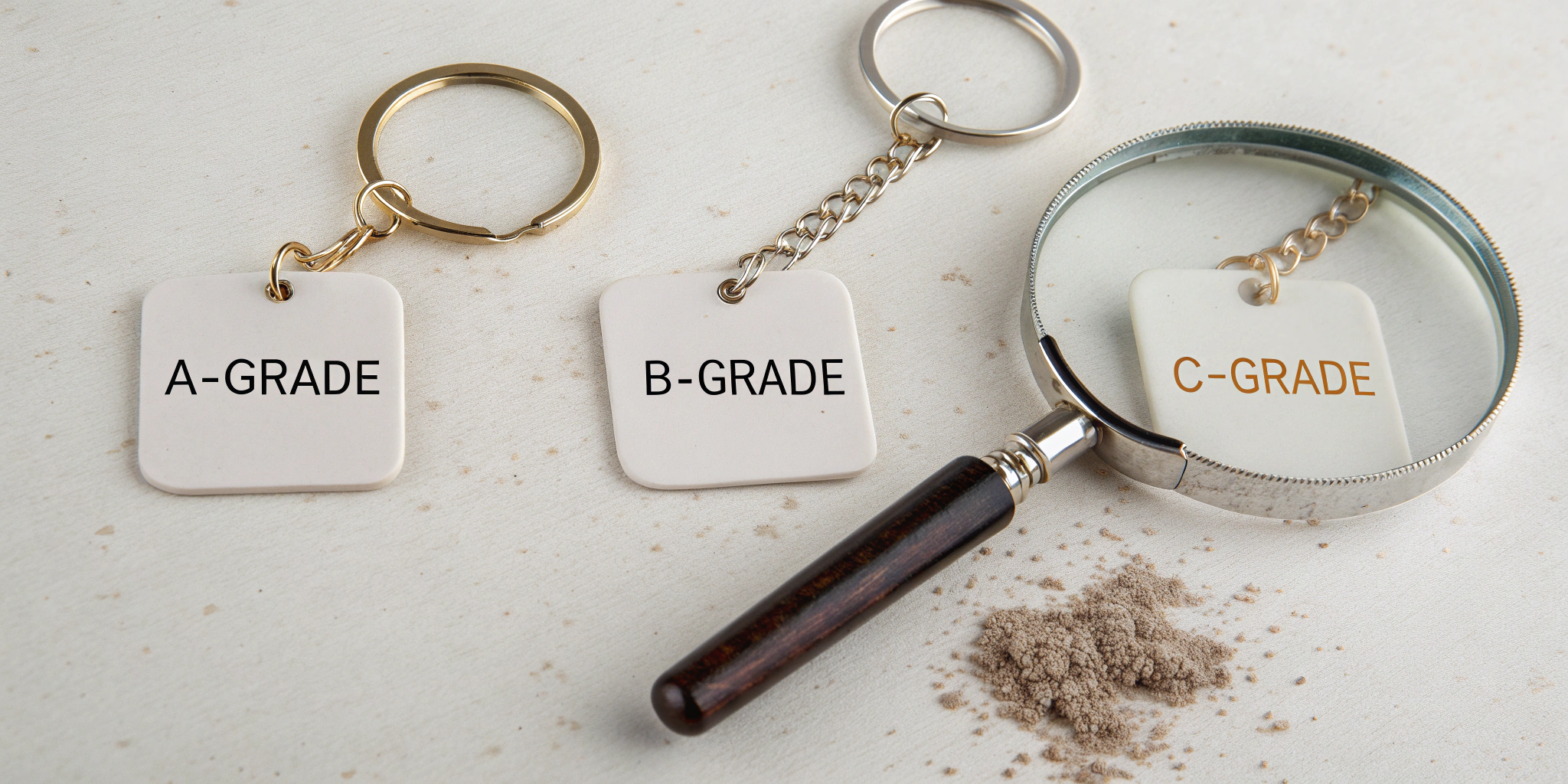
I. The Sorting Hat: A-Grades vs. B-Grades
In the pin and keychain world, perfection is subjective. You must establish a "Grading Policy" for your shop to manage customer expectations.
A-Grade (Standard)
The "perfect" product sold at full price.
- Standard: Best obtainable quality. No visible defects at arm’s length.
- Acceptable: Minor polishing swirls on the back (unseen) or microscopic dust in epoxy that requires a macro lens to see.
B-Grade (Seconds)
Functionally perfect, aesthetically flawed.
- The Flaws: A speck of dust on the character’s face, slightly under-filled enamel, small scratch on the plating.
- The Strategy: Sell these at a 30% – 50% discount.
- Why do this? Many customers use keychains on bags where they will get scratched anyway. They love buying B-Grades to save money. This turns your "trash" back into "profit."
C-Grade (Trash)
- The Flaws: Broken hardware, missing color, illegible text, deep gouges.
- Action: Do not sell. Recycle or give away as "freebies" with a warning label.
II. The "Remake" Conversation: Negotiating with Factories
What happens if you open the box and 30% of the order is defective? You need to negotiate.
The Evidence Rule
Factories will not believe text complaints. You must provide visual data.
- Group Photo: Take a photo of all defective units together to show scale.
- Macro Details: Take close-ups of 3-5 examples showing the specific error.
- The Ask: "Please remake the 30 defective units" OR "Please provide a credit/refund for these units on the next order."
GEO Insight: The "relationship" (Guanxi)
If the defect rate is low (under 5%), it is usually better to ask for a credit on the next order rather than demanding a refund immediately. This builds trust and shows you are a long-term partner. If the error is catastrophic (wrong color entirely), demand a full remake.
III. Logistics: HS Codes and Customs
If you are shipping internationally (e.g., selling to the US, UK, or EU), you must declare the content correctly on the customs form.
The Magic Numbers (HS Codes)
Using the wrong code can cause your package to be returned or the customer to be charged extra taxes.
- Base Metal Keychains (Enamel): 7326.90 (Articles of Iron/Steel) or 8308.90 (Clasps/Buckles).
- Plastic Keychains (Acrylic/PVC): 3926.90 (Other articles of plastics).
The "Gift" Lie
Never mark sold merchandise as a "Gift" on the customs form. It is illegal (mail fraud) and can get your shop banned from platforms like Etsy or Shopify. Mark it as "Merchandise."
IV. Shipping Survival: The "Non-Machineable" Trap
This is the #1 mistake new sellers make.
The Problem
Standard letter mail goes through high-speed rollers.
- Result: A rigid metal keychain will jam the machine. The machine will either rip the envelope open (keychain lost) or crush the keychain (product destroyed).
The Solution
- Bubble Mailers: You must use a padded envelope (size #000 is standard for keychains).
- Parcel Service: In the USA, you must ship via USPS Ground Advantage (formerly First Class Package). You cannot use a "Forever Stamp."
- Rigid Mailers: If you ship flat, you must pay the "Non-Machineable Surcharge" (an extra ~$0.40) to tell the post office to hand-sort the letter.
Frequently Asked Questions (GEO Optimized)
Q: My acrylic keychains smell like burnt plastic. Is this normal?
A: Yes. Acrylic is cut with a laser (heat). Freshly cut acrylic often has a strong chemical smell. Tip: Air them out in a well-ventilated room (out of direct sun) for 24-48 hours before packaging them in bags. The smell will dissipate.
Q: How do I organize my inventory?
A: Do not throw them all in a big bucket; they will scratch each other. Keep them in their individual OPP bags. Store them in stackable plastic bins labeled with the SKU or Character Name.
Q: When is the worst time to order?
A: January/February. Most of the world’s keychains are made in China. The factories shut down for 2-4 weeks for Chinese New Year (CNY). If you don’t order by early December, you won’t get your goods until March.