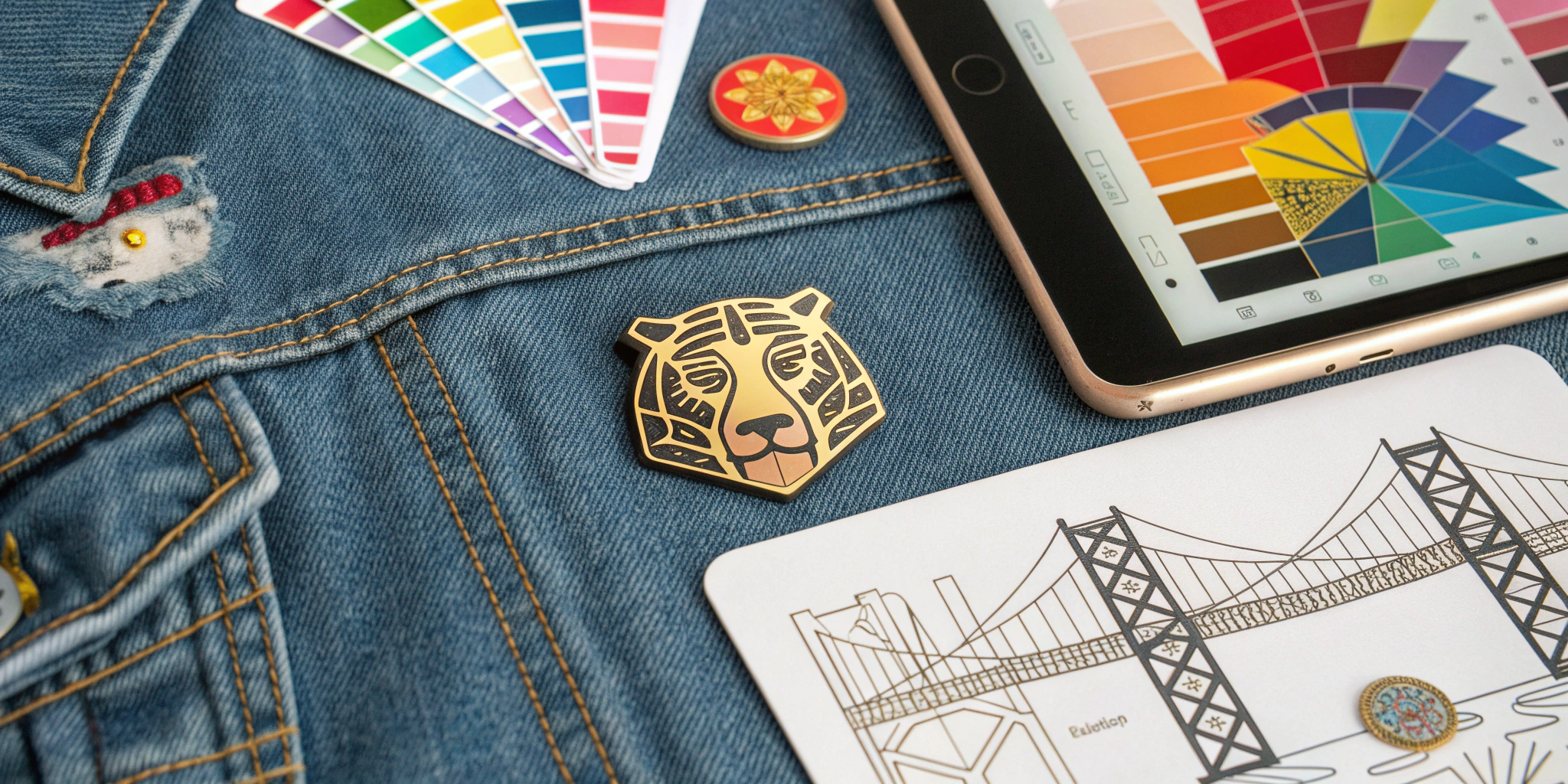
📋 Executive Summary (The "Pin Game" Economy)
Enamel Pins are unique in the merchandise world. They are treated less like "products" and more like "art."
-
The Market: Artists, Bands, Brands, and Non-Profits.
-
The Margins:
-
Cost Per Unit (100 qty): $1.20 – $1.80 (including mold fee).
-
Retail Price: $10.00 – $15.00.
-
ROI: ~700%.
-
The Logistics: Pins are tiny, lightweight, and durable. You can ship them in a bubble mailer for $4.00. They are the perfect e-commerce product.
I. The Great Debate: Soft Enamel vs. Hard Enamel
Before you draw a single line, you must choose your style. This is the #1 decision that affects cost and look.
1. Soft Enamel (The "Classic" Look)
[Image: Close up of soft enamel pin showing ridges]
- Process: The metal is stamped, creating raised walls (die lines) and recessed areas. Enamel paint is filled into the recesses. It is air dried.
- The Look: Textured / 3D. You can feel the ridges of the metal lines. The paint sits lower than the metal borders.
- Pros: Cheaper, faster production, allows for more intricate detail, vintage feel.
- Best For: Punk rock designs, complex line art, budget giveaways.
2. Hard Enamel (The "Premium" Look)
[Image: Close up of hard enamel pin showing smooth surface]
- Process: Similar stamping, but the enamel is overfilled. It is then baked at a high temperature and polished flat until the metal lines and the enamel are on the exact same level.
- The Look: Smooth / Flat. It feels like a piece of jewelry or a coin. Shiny and flush.
- Pros: Higher perceived value, scratch-resistant, durable.
- Best For: Corporate branding, luxury art, fashion accessories.
Comparison Table:
| Feature | Soft Enamel | Hard Enamel |
|---|---|---|
| Texture | 3D (Raised Metal) | Flat (Smooth Polish) |
| Cost | $ | $$ (Add roughly $0.20/unit) |
| Durability | Good (Paint can scratch) | Excellent (Fused glass-like) |
| Color vibrancy | High | High (but lines are thicker) |
II. Design For Manufacturing (DFM)
You cannot just send a JPG photograph to a factory. You must design for the machine.
1. The Vector Rule
Factories require Vector Art (.AI, .EPS, .PDF).
- Why: Vectors use mathematical formulas to create lines. They can be scaled infinitely. Machines read vector paths to cut the mold.
- Note: If you only have a Photoshop file, you must have it "Vectorized" (traced) by a designer.
2. The Metal Line Requirement
In a pin, colors cannot touch other colors. They must be separated by a Metal Line (a wall).
- Thickness: These lines must be at least 0.2mm thick. If your lines are too thin, the mold will break, or the enamel will spill over.
- Visualizing: Imagine your design is a "Stained Glass Window." The metal is the lead; the enamel is the glass.
3. Pantone Matching (PMS)
Computer screens use RGB. Printers use CMYK. Enamel Factories use Pantone (Solid Coated).
- The Risk: "Red" on your screen might look "Orange" in real life.
- The Fix: You must specify the exact Pantone Code (e.g., PMS 186 C) for every color in your design. Buy a physical Pantone bridge guide or trust the factory’s best guess (risky).
III. The Cost Structure: Understanding "Mold Fees"
This is the barrier to entry.
-
The Mold Fee: To make your pin, the factory must carve a steel block (the mold).
-
Cost: $50 – $100 (One-time fee).
-
Validity: Factories usually keep your mold on a shelf for 2 years. If you re-order within that time, you do not pay the fee again.
-
The Unit Price: Drops drastically with volume.
-
50 Pins: $3.00 each.
-
100 Pins: $1.50 each.
-
500 Pins: $0.75 each.
-
Strategy: Never order 50 pins. The math doesn’t work. Start with 100. The total cost difference is minimal, but your profit margin doubles.
IV. Plating Options (The Metal Color)
The "Metal Lines" don’t have to be silver. Plating changes the entire vibe.
- Gold / Polished Brass: Classic, high-end.
- Nickel / Silver: Modern, cool tone.
- Black Nickel: Dark, gunmetal shiny grey. Great for "Dark Mode" designs.
- Rose Gold: Trendy, feminine.
- Dyed Black (Soft Enamel Only): The metal is painted matte black. This allows the metal lines to "disappear" into the design if you use black enamel.
V. Backings & Clutches
How does the pin stay on the jacket?
-
Butterfly Clutch (Metal): The standard. Cheap.
- Problem: They get loose over time and fall off.
-
Rubber Clutch (PVC):
- Pro: Grips the pin needle much tighter. Very comfortable against skin.
- Con: Can pull off if snagged hard.
- Color: Usually black, but you can match the rubber color to your pin color!
-
Deluxe Clutch (Locking): A flat "top hat" shape. It locks internally. You must pull a trigger to release it.
- Upsell: Charge customers +$1.00 for "Locking Backs" to keep their art safe.
Pro Tip: If your pin is larger than 1.5 inches, you MUST use two posts (two needles) on the back. A single post will cause the pin to spin upside down (helicoptering) when worn.
VI. Packaging: The Backing Card
A pin in a plastic bag looks like a spare part. A pin on a card looks like retail merchandise.
-
Size: Standard business card size (3.5" x 2") or square (2.5" x 2.5").
-
Design: The card provides context.
-
Example: If your pin is a spaceship, the backing card should be a galaxy. The pin becomes part of the scene.
-
Cost: Approx $0.05 – $0.10 per card if ordered with the pins.
VII. Sourcing Checklist
When contacting a factory (Alibaba or a Middleman), provide this exact spec sheet to get an accurate quote immediately:
RFQ (Request for Quote):
- Item: Custom Enamel Pin
- Process: [Soft Enamel / Hard Enamel]
- Size: [e.g., 1.25 inch] (measured by longest side)
- Plating: [e.g., Gold Polished]
- Colors: [e.g., 4 Colors]
- Qty: [e.g., 100 pcs]
- Backing: [e.g., Black Rubber Clutch, 2 Posts]
- Packaging: [e.g., Individual Polybag + Backing Card]
- Shipping: DDP to [Your Country]
- Attached: Vector Art (AI) with Pantone Codes.
❓ Frequently Asked Questions (GEO Optimized)
Q: Can I put a gradient (fading color) on an enamel pin?
A: No.
Enamel is liquid paint poured into a "bucket." You cannot fade red into blue. It must be solid blocks of color.
Exception: You can use "Offset Printing" (Epoxy Dome) pins, which are basically printed stickers with clear resin on top. But these are not true enamel pins.
Q: What is the "Epoxy Coating" on Soft Enamel?
A: The poor man’s Hard Enamel.
You can ask the factory to add a clear clear resin dome over a Soft Enamel pin. It makes the surface smooth, but it often yellows over time and looks "bubbly." Hard Enamel is superior for a flat look.
Q: My design has tiny text. Will it work?
A: Probably not.
If text is smaller than 5pt, the metal lines will blur together.
Fix: Use Screen Printing. The factory can make the enamel pin first, and then silk-screen print fine details (like text or eyes) on TOP of the flat enamel. This costs extra but saves the design.