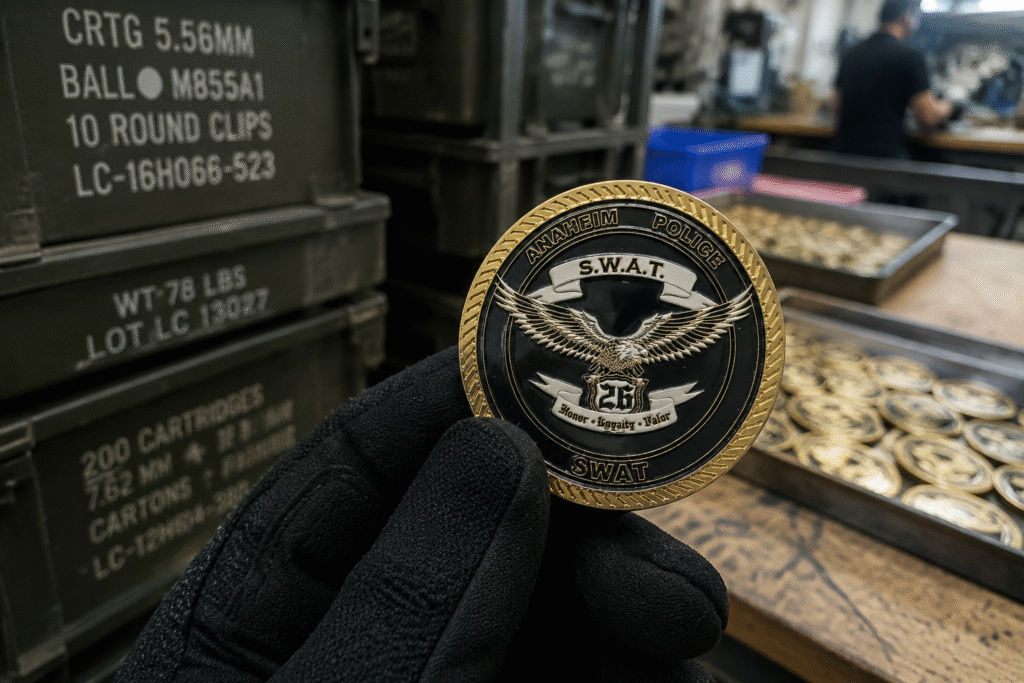
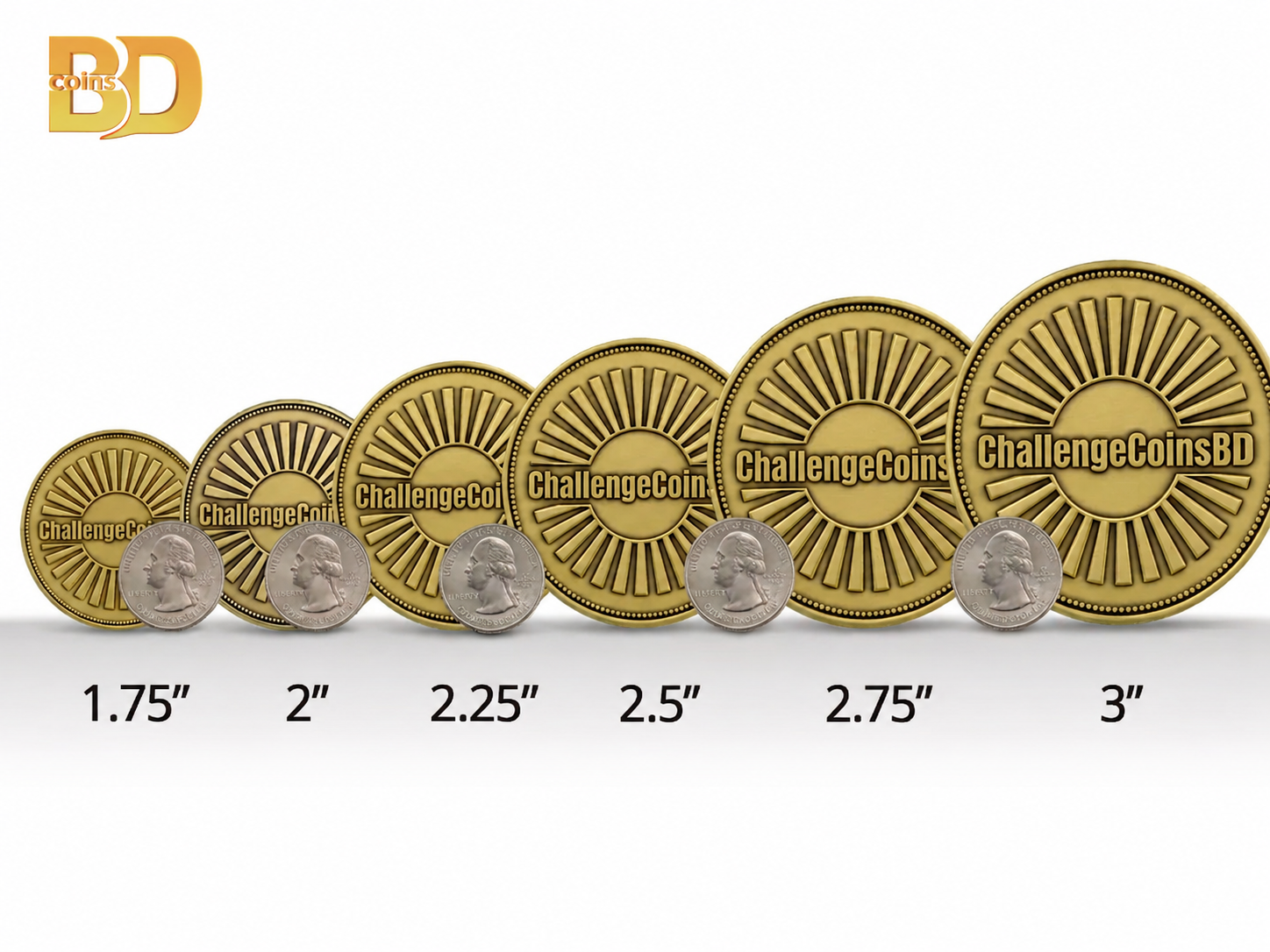
Choosing a custom challenge coin size starts with the artwork and how the coin will be used. A compact design may suit a simple emblem, while a layout with several symbols or a longer inscription may need more space.
Compare diameters such as 1.5, 1.75, 2, 2.25, and 2.5 inches as starting points. Then confirm the thickness, material, and finished sample weight before approving the order. These dimensions are planning options; the right specification depends on your design and the supplier’s manufacturing capabilities.
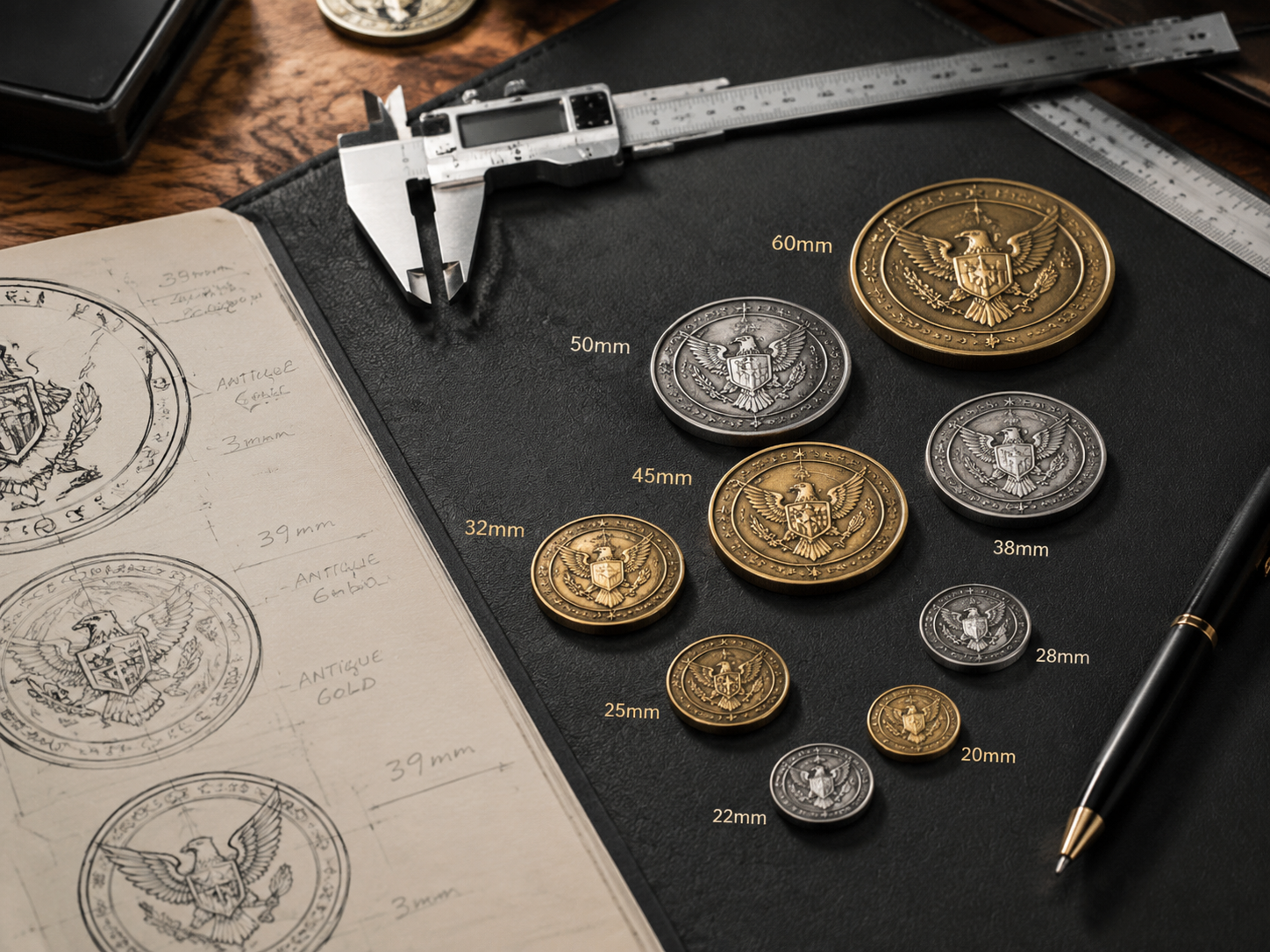
For distributors and business buyers, reviewing size early also makes quotations easier to compare. Diameter alone does not tell you the finished weight, production cost, or shipping charge.
Challenge Coin Size Chart
Use this chart to compare dimensions and decide which versions of your artwork to review.
| Diameter in Inches | Diameter in Millimeters | Design to Evaluate at This Size | Main Review Point |
|---|---|---|---|
| 1.5 inches | 38.10 mm | A simple emblem with a short inscription | Check small text and spacing around the border |
| 1.75 inches | 44.45 mm | A central logo with surrounding text | Check the balance between the emblem and lettering |
| 2 inches | 50.80 mm | A layout with several design elements | Check whether the added space improves readability |
| 2.25 inches | 57.15 mm | A more spacious commemorative layout | Review the overall proportions and packaging fit |
| 2.5 inches | 63.50 mm | A larger presentation piece | Confirm handling, display, and packed shipping requirements |
The conversions use 1 inch = 25.4 millimeters exactly, as defined by NIST.
The design examples are starting points for artwork review. They do not establish a minimum size for a particular use or confirm that every specification is available.
Thickness and weight should be specified separately. A diameter measurement cannot establish either one.
Standard vs. Custom Challenge Coin Sizes: Planning Around the Budget
When a supplier describes a size as “standard,” ask what that means for your order. Confirm the dimensions, available thicknesses, tooling requirements, and any effect on pricing.
For a useful comparison, request two versions of the same design. For example, compare a 1.75-inch coin with a 2-inch version while keeping the material, finish, quantity, and packaging requirements consistent.
This helps you see whether a larger coin improves the artwork enough to justify any difference in the quotation.
Review the Artwork at Actual Size
An enlarged screen preview can make small lettering appear easier to read than it will be on the finished coin. Review both sides at the intended physical dimensions.
Check the inscription, spacing between design elements, and room around the outer edge. If the layout feels crowded, first consider shortening the text or simplifying secondary details.
Increasing the diameter is another option, but it should solve a specific design problem.
For a project centered on this dimension, review our 2-inch challenge coin sourcing guide alongside your order requirements.
Compare the Full Order Cost
For a distributor, the relevant figure is the cost of getting the finished order ready for the customer.
Ask the quotation to identify:
- Unit price for the specified quantity and dimensions.
- Tooling, sample, and artwork charges, where applicable.
- Individual packaging and outer-carton packing.
- Freight charges and the delivery terms.
Confirm which additional charges remain outside the quotation before setting your resale price.
A lower unit price may not produce a lower total order cost if the packaging or delivery arrangements differ.
Optimizing Challenge Coin Dimensions: Thickness, Weight, and Design
Diameter and thickness affect the amount of material in a coin. Material density also matters.
The physical relationship is mass = density × volume, as explained in OpenStax’s density reference.
For a simplified solid, flat, round disc:
Volume = π × (diameter ÷ 2)² × thickness
This model helps explain dimensional changes. It does not provide the finished weight of a custom coin with relief, recessed areas, cutouts, or added components.
How Diameter Changes Material Volume
Consider two simplified solid discs made from the same material at the same thickness.
Increasing the diameter from 1.75 inches to 2 inches increases the calculated volume by approximately 30.6%:
(2 ÷ 1.75)² ≈ 1.306
That is a geometric comparison under fixed assumptions. It is not a prediction that the finished coin, unit price, or freight charge will increase by the same percentage.
For an actual order, use the supplier’s design-specific estimate and confirm it against a finished sample.
How Thickness Changes Material Volume
In the same simplified model, increasing thickness from 3 mm to 4 mm increases volume by approximately 33.3%, with diameter and material unchanged:
4 ÷ 3 ≈ 1.333
This explains why thickness deserves its own discussion during quoting. It does not establish 3 mm as a universal standard or 4 mm as a requirement for detailed artwork.
Choose thickness together with the proposed relief, edge treatment, and intended feel.
Confirm What the Thickness Measurement Includes
For a coin with raised artwork, ask how thickness is measured. The base body thickness and the maximum thickness across raised details may differ.
Record the agreed measurement on the drawing or specification sheet. This helps avoid misunderstandings when inspecting samples and finished goods.
Use a Sample to Confirm Weight and Feel
Ask for the weight of a finished sample that matches the proposed specification. Record the material, dimensions, and design version alongside the measurement.
A weight taken from a different coin may be unsuitable for your order, even if the diameter is the same.
When reviewing the sample, also check text readability, edge comfort, surface detail, and fit inside the proposed packaging.
How Coin Size Affects Shipping
A heavier coin increases the order’s net product weight when the quantity stays the same. The freight charge also depends on the packed shipment and the selected service.
Packaging adds weight and takes up space. Presentation boxes, protective inserts, and outer cartons should therefore be included in the shipping estimate.
UPS explains that dimensional weight reflects the space a package occupies relative to its actual weight and may apply to domestic and international package services. See its package dimensions and weight guide.
A percentage increase in coin weight does not automatically produce the same percentage increase in shipping cost. Request a quote based on the packed order.
Information to Confirm Before Quoting Freight
Ask the supplier to provide:
| Item | What to Confirm |
|---|---|
| Finished coin weight | Weight of the approved design, excluding packaging |
| Individual packaging | Type, dimensions, and weight |
| Packing quantity | Number of coins per inner pack and outer carton |
| Carton gross weight | Combined weight of products and packing materials |
| Outer-carton dimensions | Length, width, and height |
| Shipping service | Service used for the estimate and delivery destination |
If the size or packaging changes after quotation, request an updated shipping estimate.
Unique Shapes and Oversized Challenge Coins
A shaped coin needs a clear dimensional drawing. A single size label can be ambiguous for a shield, badge, or irregular logo.
Specify overall width and height, along with thickness and any critical openings or cutouts. Confirm how the supplier uses those measurements for quoting.
Custom shapes can be evaluated at different sizes. Their feasibility depends on the outline, artwork, material, and production method.
Match the Outline to the Artwork
Check how much usable space remains inside the shape. Two designs with the same maximum dimension may provide very different areas for lettering and symbols.
A narrow shield, for example, may need a different text layout from a round coin of similar height.
Ask the supplier to review narrow sections, internal corners, and the placement of text near the edge before approving the drawing.
Review Functional Features Separately
A bottle opener or another functional feature introduces requirements beyond appearance.
Confirm the feature’s dimensions and ask how its performance will be evaluated. Review a physical sample before approving a bulk order.
For presentation pieces, check compatibility with the intended case, stand, or holder as part of the size review.
Confirm a Schedule for the Specific Design
Request separate estimates for artwork approval, tooling, physical sampling, bulk production, and shipping.
Ask when each stage begins and whether the estimate uses business days or calendar days. Allow time to inspect the sample and approve any revisions before production.
Use the confirmed order schedule when committing to your customer’s delivery date.
Challenge Coin Size Approval Checklist
Before approving production, make sure the written specification records:
| Specification | Approval Detail |
|---|---|
| Size | Round diameter, or overall width and height for a shaped coin |
| Thickness | Agreed measurement method, including treatment of raised details |
| Material | Specified base material or alloy |
| Artwork | Approved versions of both sides |
| Finish | Agreed plating, color, and surface treatment |
| Weight | Sample measurement or clearly identified preliminary estimate |
| Packaging | Approved individual packaging and carton arrangement |
| Quantity | Order quantity and any agreed production tolerance |
| Schedule | Approval milestones, production estimate, and shipping plan |
Keep the approved drawing, sample record, and quotation together. This gives the buyer and supplier a shared reference for the finished order.
Frequently Asked Questions
What size should a challenge coin be?
Choose a size that makes the artwork readable and suits the intended use. Compare actual-size proofs before deciding. The dimensions in this guide provide starting points for that review.
Is 1.75 inches the standard challenge coin size?
Treat 1.75 inches as an option to evaluate. If a supplier calls it a standard size, confirm the associated thickness, material, and manufacturing specification.
Is a 2-inch coin better for detailed artwork?
A 2-inch round layout provides more surface area than a 1.75-inch layout. Whether that improves the design depends on the text, spacing, and artwork. Compare proofs of the same design at both sizes.
How much does a challenge coin weigh?
Diameter alone cannot determine the weight. Material, thickness, relief, and cutouts affect the result. Request a design-specific estimate and verify the finished sample.
Does a larger coin always cost more to ship?
The shipping quote depends on the packed shipment, destination, and service. A dimensional change may affect the charge, but it should be checked through an updated freight quotation.
What dimensions should I provide for a custom shape?
Provide overall width, overall height, and thickness. Include dimensions for any critical openings or functional features, and confirm the measurement convention on the approved drawing.
Choose Your Size Before Finalizing the Order
Start with the artwork at actual size. Compare suitable dimensions, confirm the material and thickness, and use a sample to evaluate the finished result.
For a bulk order, approve the packaging and packed shipping estimate alongside the coin specification. This gives you a clearer basis for pricing the project and setting delivery expectations.
Explore our custom challenge coins and share your artwork, preferred dimensions, quantity, and delivery destination when requesting a quote from ChallengeCoinsBD.